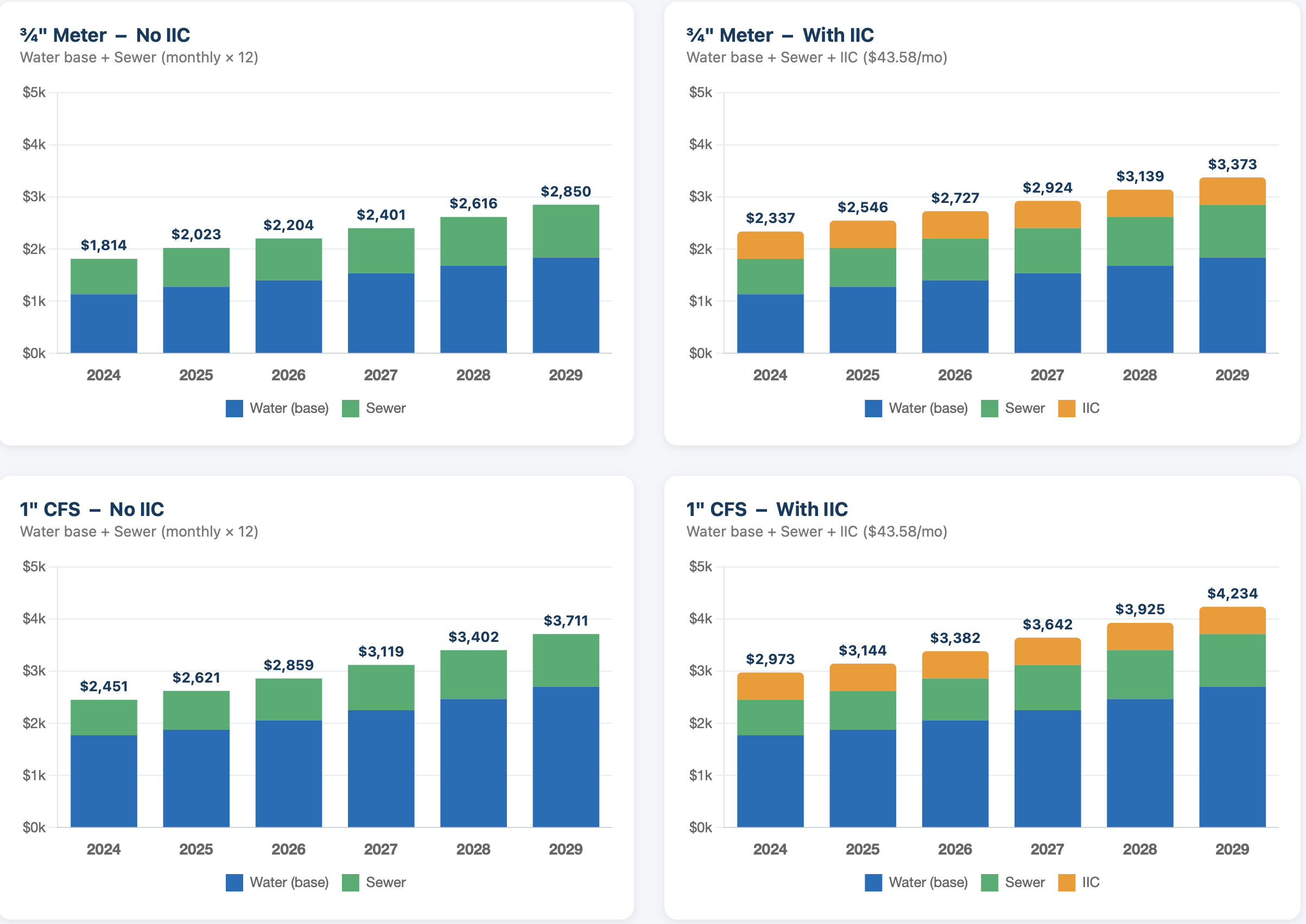
IIC: Infrastructure Improvement Charge. Reflects additional monthly fee for former Tahoe Cedars customers (Tahoma).
3/4” meter: Water rate (before usage) applicable to most homes without a built-in fire extinguisher system.
CFS: Combined Fire Service. Water rate (before usage) for most homes with a built-in fire extinguisher system
Forecast Future Rate Increases
In 2018, the Tahoe City Public Utility District purchased the privately-owned Tahoe Cedars water system for $4 million. This water system has had numerous recent failures. In addition, there is not an adequate number of fire hydrants, and the water mains lack the capacity for sustained firefighting efforts. Accordingly, TCPUD determined to entirely replace the old water system with larger mains, relocated streetside, and with the addition of a significant number of new fire hydrants.
The projected rates below are from the 2024 Rate Study, and show the maximum allowable rates permitted under Proposition 218 through 2029. The long-term rate study from 2024 calculated future utility rates based on then-current project costs for the Tahoe Cedars rebuild, and contemplates funding most of the cost of this project with debt. Debt service payments are the primary driver of the rate increases which range (overall) from 42-57%.
TCPUD currently has about $56M in cash, spread across three “pockets” which are water, sewer, and general. TCPUD has the ability to use a substantial portion of this cash on hand (water and potentially general) to fund the Tahoe Cedars project, and therefore significantly reduce the debt required for its completion. Similarly, the increases in sewer rates could potentially be offset by cash in the sewer fund. Such decisions would lower debt service payments, and therefore reduce the rate increases shown here.
Finally, comparing the cash on hand at TCPUD to our neighboring districts, NTPUD, STPUD, and TDPUD, shows that the cash at TCPUD is much higher (on a per-customer basis) than any of the other districts, suggesting that using some of this cash would not be an imprudent decision. Rainy day funds are for a rainy day - the high cost of this important project seems like an appropriate use of these cash reserves.